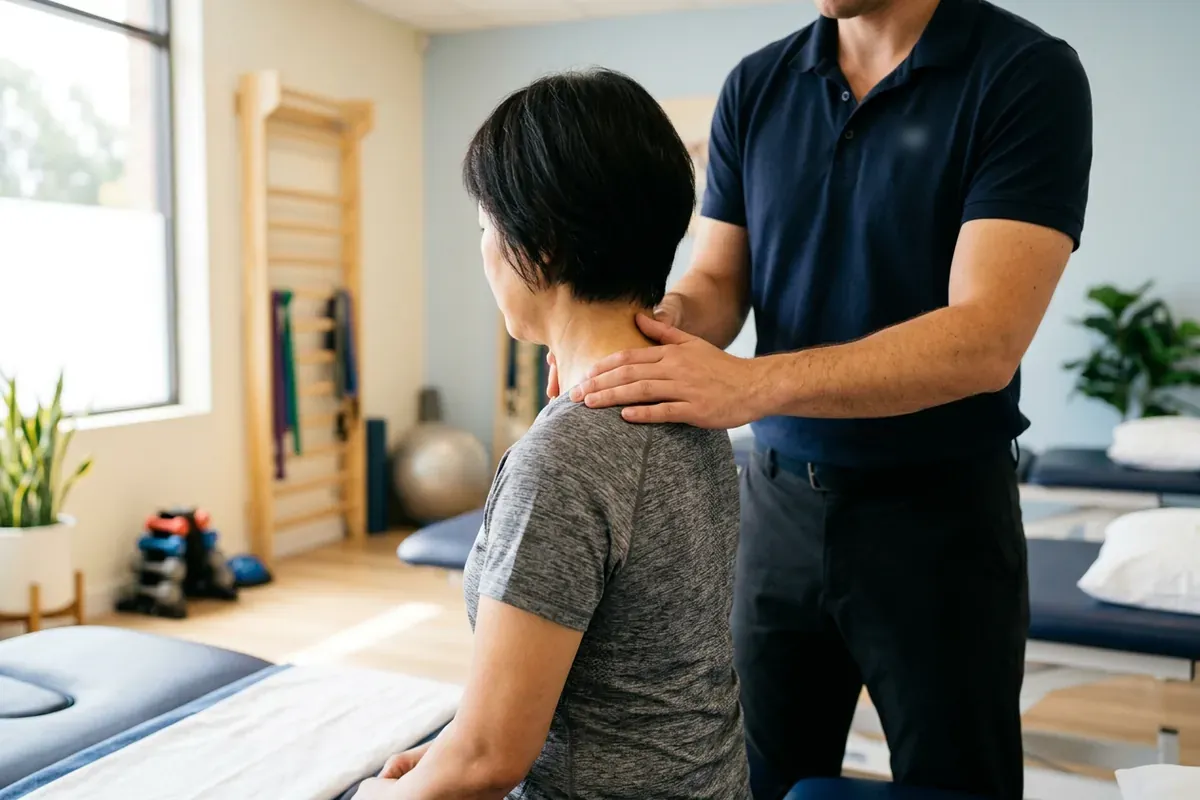
Hours on a laptop, a long commute, a phone held at chest level all evening. By the end of the day your neck feels tight, your shoulders creep up toward your ears, and turning your head to back out of the driveway takes effort. People call it “tech neck.” Here is what is really going on, what you can do at home, and when a physical therapist can help.
This article follows the APTA clinical practice guideline Neck Pain: Revision 2017 (Blanpied et al., Journal of Orthopaedic & Sports Physical Therapy, 2017), developed by APTA’s Orthopaedic Section. Guideline recommendations are paraphrased for patients. Letters in brackets show the guideline’s own grade for each recommendation: [A] strong evidence, [B] moderate, [C] weak, [D] conflicting, [E] theoretical or foundational, [F] expert opinion.
Neck pain is common. The American Physical Therapy Association estimates that it affects about 3% of people in the U.S. each year, and that there is a 20% chance a person will have neck pain within the next year. It most often affects adults between 40 and 70 (ChoosePT). The encouraging part: most episodes do not need surgery, and many people feel better within six to 12 weeks (ChoosePT).
What “Tech Neck” Really Means
“Tech neck” is not a medical diagnosis. It is a nickname for neck and upper-back pain that shows up when we spend long stretches looking down at screens or sitting in one position. The neck supports the weight of the head and moves a lot, which also leaves it less protected than the rest of the spine (AAOS).
Posture matters, but it is only one piece of the picture. The most common causes of neck pain are muscle and ligament strains and age-related wear and tear in the joints and disks (AAOS). Risk factors include older age, high job demands, smoking, limited support at work or at home, and a past history of back pain (ChoosePT). That is why a good plan looks at your whole day, not just how you sit.
Common Signs
- Stiffness, or trouble turning your head or looking up
- Aching, sharp, or burning pain in the neck, upper back, or shoulder blades
- Tight muscles or spasms
- Headaches that start at the base of the skull
- Pain, tingling, or numbness that travels into the arm or hand, sometimes with weakness. This is called radiculopathy, and it happens when a nerve in the neck is irritated (ChoosePT).
Simple Steps You Can Start Today
These tips come from APTA’s patient guidance and everyday ergonomics. They are a starting point, not a treatment plan.
- Stay active. Avoid long bed rest. Short walks several times a day can ease pain and stiffness (ChoosePT).
- Move your neck gently within a comfortable range, and avoid the activities that clearly make your neck or arm symptoms worse (ChoosePT).
- Raise your screen. Bring your phone up toward eye level, and put a laptop on a stand with a separate keyboard so you are not looking down for hours.
- Change positions often. No single posture is perfect. Getting up, rolling your shoulders, and looking around every so often helps more than holding one “perfect” position.
- Sit in a firm chair. Soft couches and easy chairs may make neck problems worse (ChoosePT).
- Try moist heat or an ice pack for short-term comfort (ChoosePT).
- Keep muscles strong and flexible, stay at a healthy weight, and if you smoke, quitting helps your spine too (ChoosePT).
For desk setup and lifting tips, see our post on ergonomics, posture and lifting for desk and physical jobs.
Stiff Neck: Common Causes and What Helps
A stiff neck usually means sore, tight muscles that make it hard to turn your head to one side (MedlinePlus). Most of the time the cause is everyday strain or tension, such as (MedlinePlus):
- Bending over a desk, laptop or phone for an hour or more
- Slouching while watching TV or reading
- A computer monitor that sits too high or too low
- Sleeping in an awkward position
- Jerking or twisting the neck during exercise, or lifting something too quickly
Arthritis in the neck, a bulging or ruptured disk, narrowing of the spinal canal, and sprains can also cause stiffness (MedlinePlus). For minor, everyday stiffness, what tends to help is gentle movement instead of keeping the neck still, ice for the first 48 to 72 hours and then heat, a supportive pillow, and staying as active as you comfortably can rather than resting in bed (MedlinePlus). Most mild to moderate neck pain gets better within 2 to 3 weeks with simple self-care (Mayo Clinic).
One stiff neck is an emergency: if you have a fever and headache and your neck is so stiff you cannot touch your chin to your chest, call 911 or go to a hospital. This can be a sign of meningitis (MedlinePlus).
How to Relieve Neck Pain at Home
These gentle steps are for everyday neck pain without any of the warning signs listed further down. Move slowly and stay in a comfortable range.
- Gentle chin tucks. Sit or stand tall with your chin level. Glide your head straight back, as if making a double chin, so your ear lines up over your shoulder (VA). Hold 3 to 5 seconds and relax. Start with 5 to 10 a few times a day. Do not tip your head up or down.
- Shoulder rolls. Slowly roll your shoulders up, back and down 5 to 10 times. Slow shoulder rolls and gently tilting and turning the head can help as pain eases (Mayo Clinic).
- Heat or ice. Use ice for the first 48 to 72 hours, then heat such as a warm shower or a heating pad on low (MedlinePlus). Keep a cloth between your skin and the pack, limit ice to about 15 minutes at a time (Mayo Clinic), and never fall asleep with a heating pad or ice bag in place (MedlinePlus).
- Posture breaks. If you work at a desk, stretch your neck every hour or so, use a headset for long calls, and put documents in a holder at eye level (MedlinePlus).
- Sleep position. Try a firm mattress and a pillow that supports your neck, so your head is not propped up high or dropping down (MedlinePlus).
When to stop and call
Stop any home exercise that makes pain spread into your arm or get worse. Contact your doctor or a physical therapist if you have numbness, tingling or weakness in your arm or hand, pain that wakes you at night or gets worse lying down, or symptoms that do not improve after about a week of self-care (MedlinePlus). Neck pain after a fall, blow or other injury needs medical care first (MedlinePlus).
How a Physical Therapist Treats Neck Pain
Your first visit starts with questions about how the pain began, what makes it better or worse, and what you are having trouble doing. Your therapist checks how your neck and upper back move, your strength, posture, reflexes and skin sensation (ChoosePT). The 2017 guideline asks therapists to screen every patient for signs of a serious problem, such as infection, cancer, heart involvement, artery problems, ligament instability or fracture, and to refer you to a doctor when needed [A] (Neck Pain CPG, JOSPT 2017).
The guideline then sorts neck pain into four groups based on your exam: neck pain with limited motion, neck pain with movement coordination problems (including whiplash), neck pain with headaches, and neck pain that travels into the arm [C]. Treatment is matched to the group and to how long you have had symptoms. Its recommendations include (Neck Pain CPG, JOSPT 2017):
- Recent neck pain with stiffness: manipulation of the upper back (thoracic spine), neck range-of-motion exercises, and shoulder-blade and arm strengthening [B]. Neck manipulation or mobilization may also be used [C].
- Neck pain that has lasted a few weeks or more (subacute): endurance exercises for the neck and shoulder girdle [B].
- Long-lasting (chronic) neck pain with stiffness: a combined program of upper-back and neck manipulation or mobilization, mixed exercise (coordination, posture, stretching, strengthening, endurance and aerobic work), and dry needling, laser or intermittent traction [B].
- Early after whiplash: advice to get back to your normal, non-painful activities as soon as possible, to use a neck collar as little as possible, and to do posture and mobility exercises, plus reassurance that recovery is expected within the first two to three months [B].
- Neck pain with headaches: supervised active mobility exercise early on [B]; for long-lasting headaches, neck or neck-and-upper-back manipulation or mobilization combined with stretching, strengthening and endurance exercise [B].
- Long-lasting pain that travels into the arm: intermittent mechanical neck traction combined with stretching, strengthening and mobilization or manipulation [B], plus education and encouragement to stay involved in work and exercise [B].
You also leave with a home program, because the exercises you do between visits are a big part of getting better and staying better (ChoosePT).
At Holsman, dry needling is available at our Lyndhurst, Caldwell, Fair Lawn and Cedar Grove clinics. Medicare does not cover dry needling, and many other plans do not either; see our dry needling page for details.
Track Your Progress
The guideline recommends using validated questionnaires to record your starting point and track changes in pain, function and disability [A] (Neck Pain CPG, JOSPT 2017). Our free online tools include the Pain Disability Index, which looks at how pain affects daily life, and the Upper Extremity Functional Index for arm and hand tasks if your symptoms travel into the arm. Bring your scores to your visit. They are not a diagnosis.
When to See a Physical Therapist
- Neck pain or stiffness that keeps coming back, or is not improving after a couple of weeks of self-care
- Trouble turning your head to drive, sleep, or work at your desk
- Headaches that seem to start in your neck
- Tingling into one arm that your doctor has checked and is not an emergency
- Neck pain after a minor car accident or a work injury. We treat auto no-fault and workers’ compensation patients; see our post on workers’ compensation physical therapy.
When to See a Doctor Right Away
This article is general education, not medical advice. Get medical care right away for:
- Severe neck pain after a car accident, fall, diving accident or other injury. Do not move the person; call 911 (AAOS).
- Numbness, tingling or weakness in both arms, or in the arms and legs (AAOS)
- Loss of coordination or fine motor skills, such as changes in handwriting, trouble with buttons, or dropping keys and cups (AAOS)
- Neck pain that is constant and severe, or comes with headaches, numbness or weakness (AAOS)
- Neck, jaw or arm pain with chest pain, shortness of breath or sweating. Call 911. Heart problems are one of the serious causes the guideline tells therapists to screen for (Neck Pain CPG, JOSPT 2017).
- Neck pain with fever, unexplained weight loss, or a history of cancer. Infection and cancer are also on the guideline’s screening list (Neck Pain CPG, JOSPT 2017).
Get Help for Neck Pain at Holsman
You can schedule physical therapy, occupational therapy and speech therapy directly. Some insurance plans require a referral for coverage; our staff will verify your benefits for free. See our insurance page for plans we work with.
Our physical therapy team treats neck pain at our New Jersey and New York clinics, including Newark, Clifton, Jersey City and the Bronx. Find the clinic nearest you, call 1-855-465-7626, or contact us to book.
Frequently Asked Questions
What is tech neck?
Tech neck is an informal name, not a diagnosis, for neck and upper-back pain linked to long periods of looking down at phones, tablets or laptops, or sitting in one position. Posture is one factor, along with strains, age-related changes, job demands, smoking and activity level.
How long does neck pain usually last?
According to the American Physical Therapy Association, many people feel better from an episode of neck pain within six to 12 weeks, and most episodes do not need surgery. Pain that keeps returning or limits your daily activities is worth an evaluation.
Is heat or ice better for a stiff neck?
Either can help for short-term comfort. APTA guidance mentions moist heat or ice packs. Use whichever feels better, protect your skin, and keep moving gently within a comfortable range.
What does a physical therapist do for neck pain?
A physical therapist checks how your neck and upper back move, your strength, posture and nerve function, and screens for serious problems. Following the APTA Neck Pain clinical practice guideline (JOSPT, 2017), treatment is matched to your type of neck pain and can include upper-back and neck manipulation or mobilization, range-of-motion, strengthening and endurance exercise, coordination and posture training, and traction for long-lasting pain that travels into the arm.
When is neck pain an emergency?
Get emergency care for severe neck pain after an injury, numbness or weakness in both arms or in the arms and legs, loss of coordination or fine motor skills, or neck, jaw or arm pain with chest pain or shortness of breath.
Do I need a referral for physical therapy for neck pain?
You can schedule physical therapy, occupational therapy and speech therapy directly. Some insurance plans require a referral for coverage; our staff will verify your benefits for free.
What causes a stiff neck?
Most stiff necks come from everyday muscle strain or tension, such as long hours bent over a desk or phone, a monitor at the wrong height, slouching, or sleeping in an awkward position. Arthritis, disk problems and sprains can also cause stiffness. A stiff neck with fever and headache, where you cannot touch your chin to your chest, needs emergency care.
How can I relieve neck pain at home?
For everyday neck pain without warning signs, try gentle chin tucks and slow shoulder rolls, ice for the first 48 to 72 hours and then heat, posture breaks every hour or so at a desk, and a pillow that supports your neck. Stop any exercise that makes pain spread into your arm or get worse.
When should I stop neck exercises and see someone?
Stop and contact your doctor or a physical therapist if pain spreads into your arm or gets worse, you have numbness, tingling or weakness in your arm or hand, the pain wakes you at night, or you are not improving after about a week of self-care.
Sources
- Blanpied PR, Gross AR, Elliott JM, et al. Neck Pain: Revision 2017. Clinical Practice Guidelines Linked to the International Classification of Functioning, Disability and Health From the Orthopaedic Section of the American Physical Therapy Association. Journal of Orthopaedic & Sports Physical Therapy. 2017;47(7):A1–A83. doi:10.2519/jospt.2017.0302. Accessed November 2026.
- Physical Therapy Guide to Neck Pain (American Physical Therapy Association, ChoosePT). Accessed November 2026.
- Neck Pain (American Academy of Orthopaedic Surgeons, OrthoInfo). Accessed November 2026.
- Neck pain (MedlinePlus Medical Encyclopedia, U.S. National Library of Medicine, reviewed 1/14/2026). Accessed November 2026.
- Neck pain or spasms - self care (MedlinePlus, U.S. National Library of Medicine, reviewed 7/3/2025). Accessed November 2026.
- Neck pain: Diagnosis and treatment (Mayo Clinic, May 13, 2026). Accessed November 2026.
- Back Basics: Self-Care for Spine and Disk Problems (U.S. Department of Veterans Affairs, Veterans Health Library). Accessed November 2026.
Related: Neuropathy & nerve pain at Holsman Physical Therapy — including pinched nerves, numbness and tingling.
This article is for general education and isn't a substitute for an evaluation by a licensed clinician.